First Aid Tools
Splints
Splints are a very important tool in caring for muscle and bone injuries. A good splint can prevent further injury by preventig fractured bones from moving unecessarily, promote recovery, and help with pain management. All splints need to be rigid and well padded. Although a splint should never be painful once positioned, they are also not always comfortable, especially when worn for extended periods of time.
A splint may be commercially prepared, improvised, or may be anatomical (using the body for support).
Commercial splints may be made of wood, flexible metal covered in foam, or corrugated plastic. They will come in different sizes and may have instructions on how to reshape them for specific injuries.
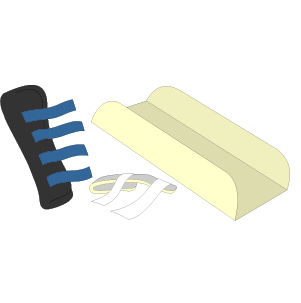
An improvised splint is created out of materials available at the emergency site. Pieces of wood, cardboard, books and magazines, pillows, rulers, and coat hangers can all be used as an improvised splint.

A good splint is:
- Rigid enough to support the injured limb.
- Well padded for support and comfort.
- Long enough to fully immobilize the injured bone or joint by extending above and below the injury.
- Lightweight so it does not add to the discomfort.
An anatomical splint uses the body to support a limb. Fingers, shoulders, upper arms, and upper legs are often immobilized using anatomical splints due to the difficulty of putting a rigid splint onto these parts.
Other Materials Needed for Splinting
In addition to the splint itself, padding and bandages are needed to properly secure a splint to the body.
Padding does two things:
- It fills in the natural hollows between the body and the splint, ensuring the injured limb is properly supported.
- It makes the splint more comfortable.
Always pad between a splint and the injured limb, and between two body parts to be bandaged together.
When using bandages:
- Make sure they are wide enough to provide firm support without discomfort.
- Pass the bandages under the natural hollows of the body. Pass the bandages between the elbow and the side, under the knee, the small of the back, the hollow behind the ankles.
- Tie them tightly enough to prevent movement, but not so tight they cut off circulation. Check circulation every 15 minutes below any bandages you have already tied.
 |
 |